
Workers in Big Sky are getting priced out of the town they keep running. Median home prices have climbed past $1.5 million, and rental vacancy sits near zero for much of the year. For service workers, hospitality staff, and longtime locals, that math simply doesn’t work. Now, employers, nonprofits, and elected officials are pushing back with workforce housing projects, public funding initiatives, and a level of coordinated effort the area hasn’t seen before.
Housing Pressures Are Reshaping Life in Big Sky
Median home prices in Big Sky have surpassed $1.5 million, and rental costs have climbed more than 40 percent over the past four years. For the teachers, restaurant workers, and resort employees who keep the community running, those numbers aren’t statistics — they’re reasons to leave.
The region’s economy runs on hospitality and recreation, which generates strong seasonal demand but not the wages to match it. A schoolteacher earning $45,000 annually cannot compete with second-home buyers from out of state, and there’s no denying the inventory is too thin to absorb both markets.
“We’re losing good people every season,” said one Big Sky resort operator. “They can’t afford to stay.”
Vacancy rates remain below two percent. Buildable land is scarce, and local zoning has historically favored high-end development over workforce units, compressing supply further.
Community Leaders Are Building a Response
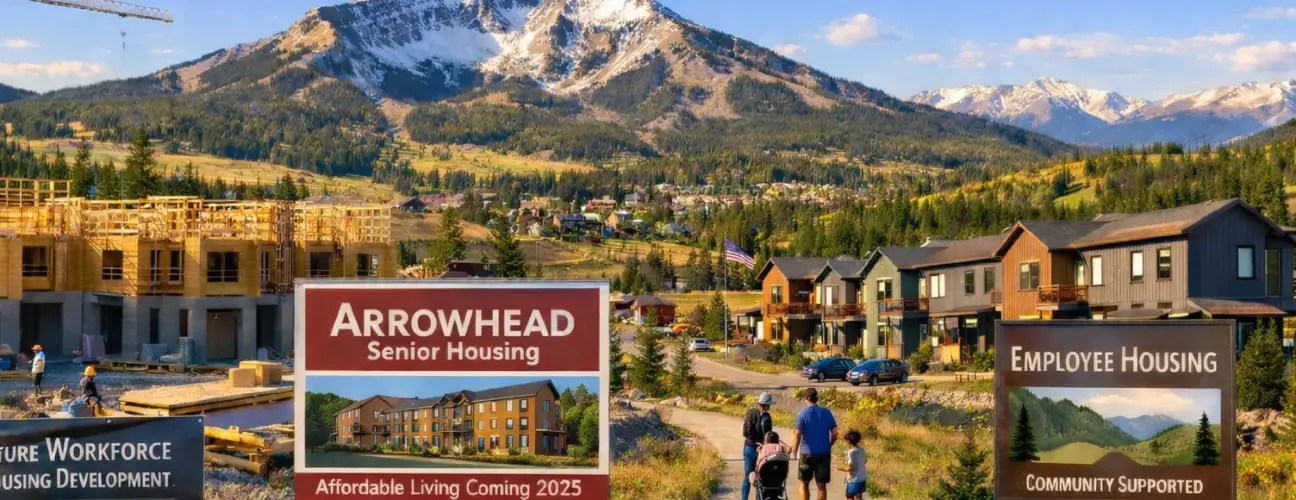
The concrete groundwork of several efforts is already in place. In addition, the Big Sky Community Housing Trust has engaged in the development of Arrowhead Senior Housing, a 40-unit affordable project expected to break ground in 2025, partly supported by the resort tax revenues raised by the community for this in 2022.
The resort tax fund has been providing approximately $1.2 million annually, which is to be used for land acquisition and workforce housing support. Some local employers, who include the Lone Mountain Land Company, are directly supporting parcels of land that are earmarked for employee housing, a model increasingly observed in resort towns across the West that share in the same problem.
An ordinance, through general fund revenue, is in the middle stages of public review in preparation for a bond issue to finance an additional 60 workforce-housing units. HRDC, a local nonprofit, has committed assistance for its workforce and calls for an inclusionary zoning ordinance. Obviously, none of these moves singly will close out the housing shortage, but together signal our hope that Big Sky’s response is real, or worth investing for.
Big Sky’s Future Depends on Sustained Housing Action
The next few years will be determinant in putting Big Sky forward as a place where teachers, lift operators, and restaurant workers can afford accommodation. One can see the social basis which housing exerts, thus a measure of the staying power of Big Sky as it stands there. Few funding plants and apartment projects have captured some much-needed momentum, but then energy is not enough. Onward memory requires sustained effort through investment. Coherent planning between developers, local governments and nonprofits, and an underpinning of public support in ballots and other venues need to prevail in Big Sky. Three units and the Big Sky community reaction are thus far where the net has fallen. Success from this point is debatable, and the call-up will be decided.